
Ireland is becoming a popular study destination for students from India and other countries because of its quality education, English-speaking environment, and good post-study work options. However, in 2025, many students are worried about Ireland student visa rejections. This is mainly because immigration rules are becoming stricter, and officers now check applications more carefully than before.
One major reason for visa rejections is small but avoidable mistakes. These include unclear proof of funds, weak or copied Statements of Purpose (SOP), missing documents, or confusion about the student’s future plans. Ireland immigration authorities clearly state that every application is assessed individually, based on documents and the applicant’s genuine intention to study. You can read more about how visa decisions are made on the official Irish Immigration website:
This situation creates fear among Indian and other international students. Many students invest a lot of money in college fees, exams, and agents, so a visa rejection feels stressful and disappointing. Students often worry about losing an academic year or damaging their chances for future visas. According to education experts, most rejections happen due to documentation issues and weak explanations, not because Ireland does not want students.
The purpose of this blog is simple: to help you understand why Ireland student visas get rejected in 2025 and how you can avoid these mistakes. If you prepare properly, submit honest documents, and clearly explain your study plan, your chances of approval are very high. This guide will help you apply with confidence and clarity.
Understanding Ireland Student Visa Rejection
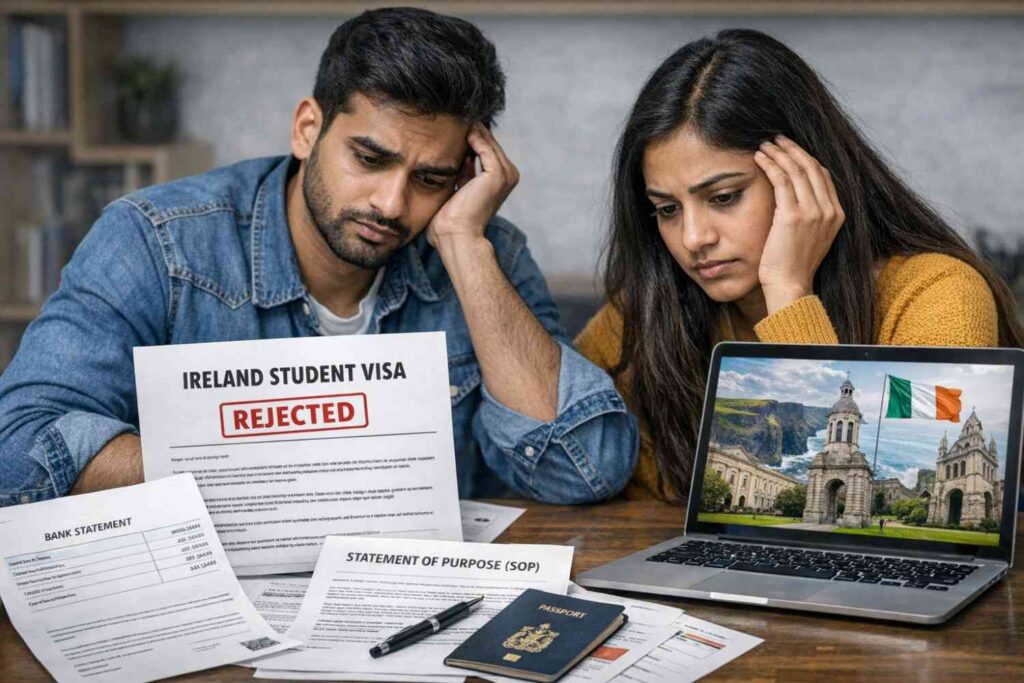
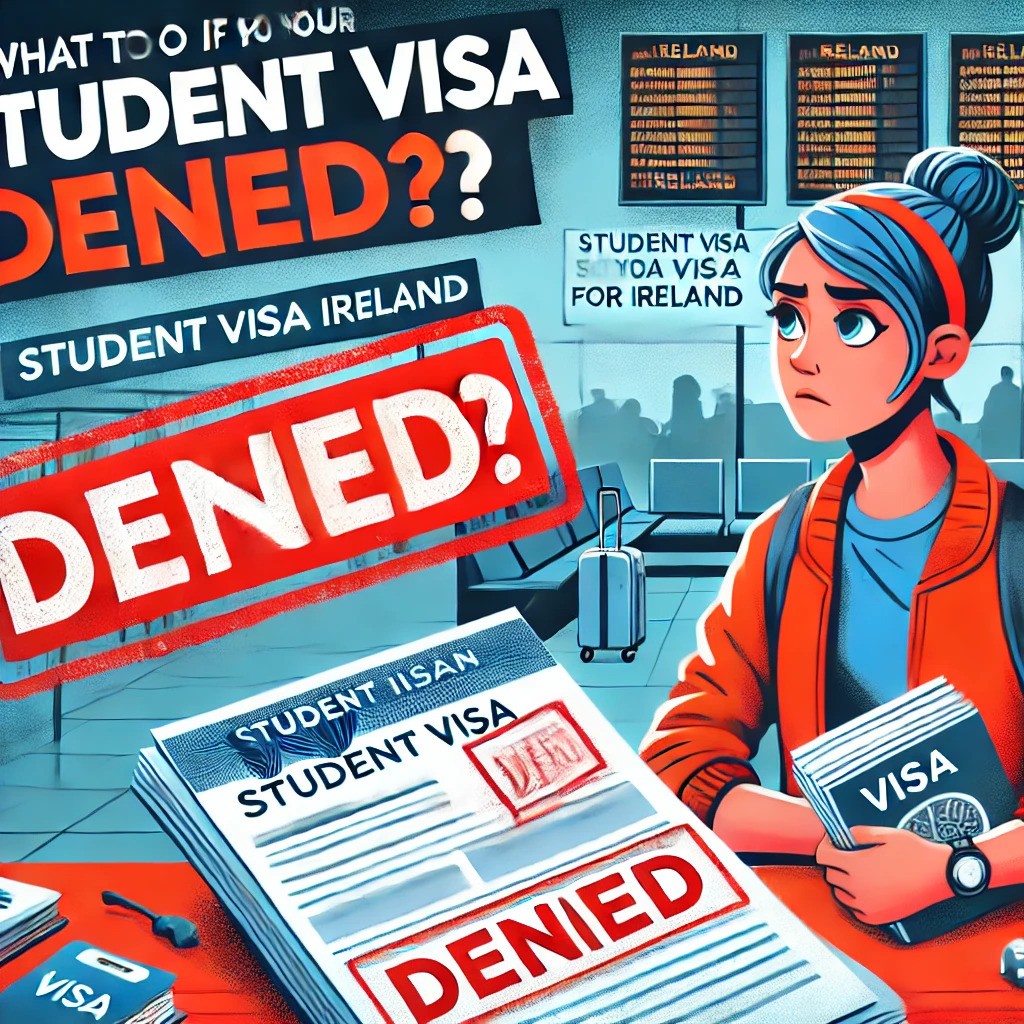
An Ireland student visa rejection means that the immigration officer is not fully satisfied with your application. It does not mean that you are not a good student or that you can never study in Ireland. It simply means that, based on the documents and explanation you submitted, the officer felt that some requirements were not clearly met.
Irish immigration officers check applications mainly for genuine study intention, financial capability, and proper documentation. If any of these areas look weak or unclear, the visa can be refused. You can read how visa decisions are assessed on the official Irish Immigration website:
Does a visa rejection affect future Ireland or other country visas?
A visa rejection does not automatically block your future visa applications for Ireland or other countries like the UK, Canada, or Australia. However, your rejection record does remain in immigration systems. This means that future applications will be checked more carefully, especially if you apply again without fixing the earlier mistakes.
If you clearly address the rejection reasons and submit stronger documents next time, many students successfully get approval. Citizens Information Ireland also confirms that refusals are based on the application, not on the applicant permanently:
Can you reapply after an Ireland student visa rejection?
Yes, you can reapply after a rejection. Ireland allows students to submit a fresh application once they improve the weak areas mentioned in the refusal letter. There is no fixed waiting period, but it is strongly advised to reapply only after correcting the issues such as funds, SOP, or missing documents.
In the next section, we will explain the most common rejection reasons in 2025 and how you can avoid them.

Top Ireland Student Visa Rejection Reasons in 2025
1. Insufficient Proof of Funds
One of the most common reasons for Ireland student visa rejection in 2025 is insufficient or unclear proof of funds. Irish immigration authorities want to be sure that you can pay your tuition fees and living expenses without financial stress while studying in Ireland.
Minimum funds requirement in 2025
As of 2025, international students must show:
- Proof that tuition fees are paid (or at least a major portion), and
- Around €10,000 or more as living expenses for one academic year
These funds must be easily accessible and clearly shown in your documents. The official requirement is explained on the Irish Immigration website:
Common mistakes in bank statements
Many applications get rejected because of:
- Sudden large cash deposits without explanation
- Bank statements not covering the required time period
- Unclear transaction history
- Statements that look edited or unofficial
Such issues create doubt about the genuineness of funds.
Sponsor income mismatch issues
If your parents or relatives are sponsoring you, their income must match the funds shown. Problems arise when:
- Sponsor income is too low compared to the savings shown
- No proper proof of income (ITR, salary slips, business proof)
- Sponsor relationship is not clearly explained
How to avoid rejection due to funds
- Maintain funds for the required duration, not just for a few days
- Use clean, official, and verifiable bank statements
- Add proper sponsor documents, including income proof and relationship proof
Clear and honest financial documents greatly increase your visa approval chances.
2. Weak or Generic Statement of Purpose (SOP)
A Statement of Purpose (SOP) is one of the most important documents for an Ireland student visa. It tells the visa officer why you want to study in Ireland, why you chose the course, and what you plan to do after completing your studies. Many visa applications get rejected because the SOP is weak, copied, or unclear.
Copy-paste SOPs from agents
Many students submit SOPs that are copied from the internet or written by agents using the same format for everyone. Visa officers can easily identify such SOPs. When your SOP looks common or robotic, it creates doubt about your genuine intention to study.
No clarity on course or career plan
Another common problem is when students cannot clearly explain:
- Why they chose this course
- How it matches their previous education or work experience
- How it will help in their future career
If your plan looks confusing or unrealistic, the visa officer may reject the application.
Over-focus on part-time work
Some SOPs talk too much about part-time jobs, money, or staying in Ireland permanently. This gives the impression that your main goal is working, not studying, which can lead to rejection.
How to avoid SOP-related rejection
- Write a personalised SOP based on your own background and goals
- Clearly link course → skills → career → return plan to India
- Keep the language simple, honest, and realistic
A clear and genuine SOP greatly improves your chances of getting an Ireland student visa.

3. Weak Academic Background or Unexplained Gaps
Another common reason for Ireland student visa rejection in 2025 is a weak academic profile or unexplained gap years. Visa officers carefully check your education history to see if you are genuinely prepared for the course you are applying for.
Long gap years without proper explanation
Many students have study gaps because of job preparation, work experience, competitive exams, or personal reasons. A gap is not a problem by itself, but it becomes an issue when:
- The gap is not explained clearly
- No documents are provided to support the gap
- The gap looks wasted or irrelevant
This creates doubt about your seriousness as a student.
Low academic scores
Low marks in previous studies can also raise concerns, especially if:
- There is no improvement shown later
- You choose a very demanding course without justification
Visa officers want to see that you can handle the academic level of the course in Ireland.
Course mismatch with previous studies
If your chosen course has no clear connection with your past education or work experience, it may look illogical. Sudden changes without explanation often lead to rejection.
How to avoid academic-related rejection
- Explain study gaps clearly in your SOP
- Add work experience, certifications, or training during gap years
- Choose a course that matches your background, or clearly justify the change
A clear academic story shows that you are a serious and genuine student.

4. Incomplete or Incorrect Documents
One of the most avoidable reasons for Ireland student visa rejection is missing, incorrect, or unclear documents. Even a strong student profile can get rejected if the documents are not submitted properly.
Missing important documents
Visa applications often get rejected when students forget to submit key documents such as:
- Complete bank statements
- Tuition fee payment proof
- Academic transcripts or certificates
- Valid passport copies
If any required document is missing, the visa officer may not process the application further.
Unclear or poor-quality documents
Documents that are:
- Blurry or poorly scanned
- Cropped or incomplete
- Not properly labelled
can create confusion. Immigration officers must clearly read and verify every document.
Incorrect or inconsistent information
If details do not match across documents, such as:
- Different names or spellings
- Mismatch in dates, fees, or course details
- Inconsistent financial figures
it raises doubts about the accuracy of your application.
Fake or unverifiable documents
Submitting fake, edited, or unverifiable documents is a serious issue. This can lead to immediate rejection and may affect future visa applications.
How to avoid document-related rejection
- Use the official visa document checklist
- Upload clear, high-quality scans
- Double-check that all details match
- Never submit fake documents
Proper and honest documentation greatly improves your chances of visa approval.

5. Doubt About Intention to Return to Home Country
One important reason for Ireland student visa rejection in 2025 is when the visa officer feels that the student may not return to their home country after completing studies. Ireland issues student visas mainly for education, not for permanent stay.
Weak ties to home country
Visa officers look for strong connections to your home country, such as:
- Family responsibilities
- Job offer or career plans
- Family business or property
- Social and financial ties
If these ties are not clearly shown, the officer may believe you intend to stay in Ireland long-term.
Overemphasis on staying in Ireland
Some students focus too much on:
- Post-study work visas
- Permanent residency (PR)
- Settling in Ireland
When this is highlighted too strongly in the SOP or interview, it creates doubt about your primary purpose of study.
No clear future plan after studies
If your application does not clearly explain what you plan to do after completing the course—especially how it benefits your career in your home country—it may look incomplete or unrealistic.
How to avoid rejection due to return intention
- Clearly explain your career plan after graduation
- Show strong family, job, or business ties to your home country
- Keep your SOP balanced: focus on study first, not settlement
A clear and honest future plan helps visa officers trust your intention.

6. Low or Invalid English Language Test Scores
English language ability is an important requirement for studying in Ireland. Many Ireland student visa applications get rejected because the English test score does not meet the required level or the test result is not valid at the time of application.
Not meeting minimum English requirements
Most Irish colleges require proof of English through tests such as IELTS, TOEFL, or PTE. Problems occur when:
- The overall score is below the course requirement
- One or more sections (reading, writing, listening, speaking) are too low
- The score does not match what the college or visa requires
Visa officers use these scores to judge whether you can understand lectures and complete assignments in English.
Expired English test scores
English test results are valid only for a limited time (usually 2 years). Submitting an expired score can lead to rejection, even if the marks were good.
Mismatch between college offer and visa file
If your college has given you a conditional offer but your visa file does not clearly explain or support it, it can create confusion and lead to refusal.
How to avoid English-related rejection
- Check course-specific English requirements carefully
- Make sure your test score is valid at the time of visa application
- Retake the test if needed to improve weak sections
- Upload clear and official score reports
Meeting the English requirement properly shows that you are academically prepared.

7. Late Application or Poor Timing
Many Ireland student visa applications get rejected or delayed simply because the student applied too late. Timing is very important in the Ireland student visa process, especially in 2025 when visa offices handle a high number of applications.
Applying too close to the course start date
If you apply just a few weeks before your course begins, there may not be enough time for:
- Proper document verification
- Additional checks by immigration officers
- Fixing any mistakes in your application
In such cases, even a good application may be refused or delayed.
Incomplete preparation before applying
Some students rush their visa application without:
- Finalising documents
- Paying tuition fees on time
- Preparing a strong SOP
Rushed applications often contain errors, missing information, or unclear explanations.
No buffer time for reapplication
If your visa is rejected and you applied late, you may not have enough time to reapply before the intake starts, which can lead to loss of an academic year.
How to avoid rejection due to poor timing
- Apply at least 2–3 months before your course start date
- Prepare all documents well in advance
- Keep buffer time for corrections or reapplication
Applying early gives you time, confidence, and a much higher chance of visa approval.